The End of Democracy?
 What is the stop, the goal of democracy? It is to allow the people to concur to account those who exercise ability over them. In our sort of representative democracy it does non mean that politicians simply do what the people vote for. Most of us take neither the time nor the expertise to brand informed decisions in a complex world, so we elect those we trust whom nosotros retrieve are qualified to make these decisions on our behalf—and so, come ballot day, we hold them to account for the decisions they have made. This has been the instance for a long time. Although we are addicted of tracing the idea of democracy dorsum to the ancient Greeks, for the Roman emperors information technology was important to plant the idea of theconsensus omnium, that the emperor governed with the understanding of the mass of the people.
That means that there will sometimes be surprises—and this election at that place take been more, and bigger, surprises than in living retentivity. Many were delighted at the big Conservative names that were toppled in 1997; just in that location take been more than Liberal Democrat and Labour big names that accept gone—Ed Balls, Vince Cable, Simon Hughes, Danny Alexander, Douglas Alexander, Charles Kennedy, Ed Davey and Jim Murphy. Just as the loss of experienced and talented Conservatives bedridden them for an electoral generation, Labour will struggle to fill some of the gaps, and I think the Liberal Democrats are over as a political force in this country, with only eight seats in the Commons, and coming fourth behind UKIP in vote share.
Heads will ringlet in other means equally well. UKIP'southward Nigel Farage volition almost certainly resign as political party leader—only then volition Nick Clegg and Ed Miliband. (As next Labour leader, my money is on Chuka Umunna, for 2 reasons. Offset, he tin can eat a bacon sandwich in public, and second, he has had business-related experience in the 'existent world', as a solicitor specialising in employment law, which gives him credibility that Miliband always lacked.) I wonder if there has been an ballot in which all the main parties other than the winner had an firsthand change of leader?
In all these means, at that place is a frisson of excitement that the people, wielding stubby pencils (mine was very chubby) in rickety booths in town halls up and down the country have power over those who, a few weeks ago, seemed immune from criticism. But is that what really happened? Here are some things worth noting from the overall results:
- Labour share of the vote went up i.4% overall, but their number of seats was downwardly by 26.
- In England, Labour share went up around 5%
- Conservative share of vote only increased past 0.7%, merely they will have 21 more seats in Parliament.
- Anti-thrift parties gained more votes overall than pro-austerity parties.
- Vote per seat [as I write] were as follows:
| Votes | Seats | Votes per seat | |
| Con | 11,162,553 | 325 | 34,346 |
| Lab | 9,236,878 | 229 | twoscore,336 |
| Lib Dem | 2,359,368 | 8 | 294,921 |
| UKIP | three,830,029 | 1 | 3,830,029 |
| Green | 1,138,445 | i | ane,138,445 |
| SNP | 1,454,436 | 56 | 25,972 |
In other words, this Parliament is now fifty-fifty less representative of the views of the people than the last, and the Conservatives have significantly increased their control without in fact persuading any more people of their case than in 2010.
Then what was going on? Well, you might not accept realised it when you voted, just in that location was someone else in the voting berth with you: money.
In the terminal election in 2010, the Conservatives spent twice as much as Labour, and it looks similar the aforementioned has happened again. The Telegraph reports that, in relation to the ballot itself, the funds were even more unbalanced:
The latest Electoral Commisison [sic] report on donations received by the political parties is out. The Conservatives' funds dwarf those of Labour – by £i.3 million to £131,000.
And the primary donors were, not surprisingly, those in the finance and business sector who stood to gain about from a Bourgeois authorities.
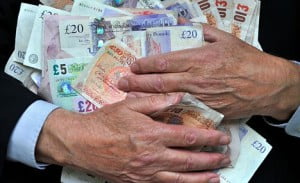
Last time around, the difference in funding did not determine the effect—merely this time spending has been more than targeted and more than effective. In 2022 the Conservatives pushed through a modify in the police force, raising the limit on national election spending, to brand the well-nigh of their advantage. And targeted campaigns in marginals (similar Broxtowe, where I vote) come under the less-tightly regulated national limits rather than the more tightly controlled local ones, as long as the mailings come from a central source. So not just were we surrounded by Conservative billboards, we also received several 'personalised' messages from David Cameron. And it worked. Despite the fact that the Labour candidate here had a much meliorate record as a local MP, there was a swing abroad from Labour and to the Conservatives in contrast to the national swing.
The 2nd way that money has influenced the election is in distribution of voting. I strongly suspect that, when all the analysis has been done, we will notice that those who have done ameliorate out of the changes to the economy, particularly in the South East, will have moved more to the Conservatives, whilst those who accept done worse, item in the north, will have moved more to Labour. In other words, Britain will now be a more than divided country after the election than it was before. And our 'first past the post' organization exaggerates this. As the issue in Scotland shows, where in that location is a concentration of interests, FPTP completely distorts the issue. Having taken almost all the UK Parliament seats for Scotland, the SNP does not fifty-fifty have a bulk in its own Scottish Associates considering the Associates runs on PR! It is sobering to remember that Hitler was elected to power through a democratic system…
So the procedure of the people holding those in power to business relationship appears to have significantly failed.
Three things need to change in our electoral system.
- Start, in that location needs to exist equal admission to funding, so that one party cannot outspend the others in the ballot campaign.
- Secondly, media outlets ought to exist regulated to offering the aforementioned balance of coverage as the BBC does, every bit a public service broadcaster.
- Thirdly, we urgently demand to reform the voting system and move to a form of PR.
Will whatever of these happen? No, of course non, since the the political party now in power has a vested involvement in maintaining the current organization as information technology is.
And for anyone concerned about the future of the NHS, for the growing inequality in income and capital distribution, for the lack of houses being congenital, for the culture of our didactics system, and for all the other issues that take not even been touched on—we will have to find other means than a skewed ballot-box to express our concerns.
Much of my piece of work is washed on a freelance footing. If you have valued this post, would yous consideraltruistic £1.20 a month to back up the production of this blog?
If you lot enjoyed this, do share information technology on social media (Facebook or Twitter) using the buttons on the left. Follow me on Twitter @psephizo. Like my folio on Facebook.
Much of my work is done on a freelance basis. If yous have valued this post, you tin can brand a single or repeat donation through PayPal:
Comments policy: Good comments that engage with the content of the post, and share in respectful debate, can add real value. Seek first to understand, and then to exist understood. Brand the about charitable construal of the views of others and seek to learn from their perspectives. Don't view debate as a conflict to win; address the statement rather than tackling the person.
Source: https://www.psephizo.com/life-ministry/the-end-of-democracy/
0 Response to "The End of Democracy?"
Post a Comment