When Will Mauna Kea Erupt Again
Information is preliminary and subject to change. All times are local (unless otherwise noted)
Dec 2013 (BGVN 38:12)  Cite this Report
In repose; background atmospheric condition and hazards
This is the first Bulletin study for Mauna Kea, the tallest volcano on the Isle of Hawai`i (figures 1, 2, and 3). Although the nearly recent eruption occurred ~iv,500 years ago, this volcano has the potential to reawaken. This written report presents early observations past Western explorers; discussions from Hawaiian Volcano Observatory (HVO) scientists focusing on the potential for future eruptions; seismicity during 2000-2013; and a recent report by HVO scientists highlighting desperate changes at an alpine lake, Lake Waiau.
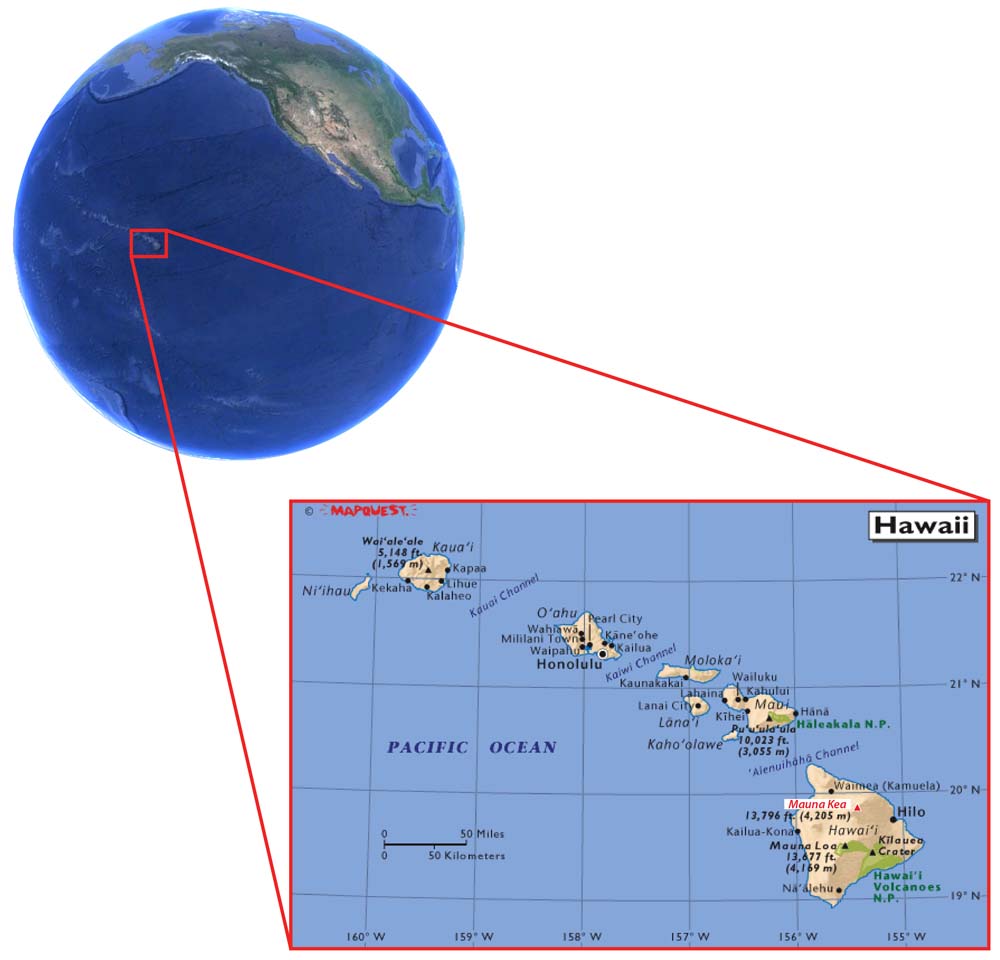 | Figure ane. Mauna Kea is one of five volcanoes comprising the Isle of Hawai`i, the others existence Kohala, Hualalai, Mauna Loa, and Kīlauea. The archipelago of Hawai`i includes the eight islands: Ni`ihau, Kaua`i, O`ahu, Moloka`i, Lana`i, Maui, Kaho`olawe, and Hawai`i (from W-to-E). Courtesy of Holt and others (2006) and Google Earth. |
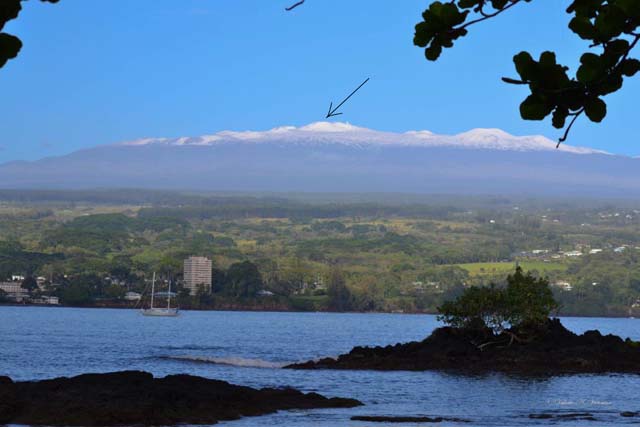 | Figure two. This view of Mauna Kea is from the Keaukaha surface area, the Due south edge of Hilo Bay. Seasonal snow covers the top surface area which is also dotted with cinder cones. The highest signal, indicated with the arrow, is located at the highest point on the rim of the cinder cone Pu`u Wekiu. The pocket-sized white points to the right of the pointer are several of the astronomical telescopes belonging to the Mauna Kea Observatories, part of the Academy of Hawai`i'due south Constitute for Astronomy. Photo past Valerie Veriato Victorine; courtesy of Hawaii News Now. |
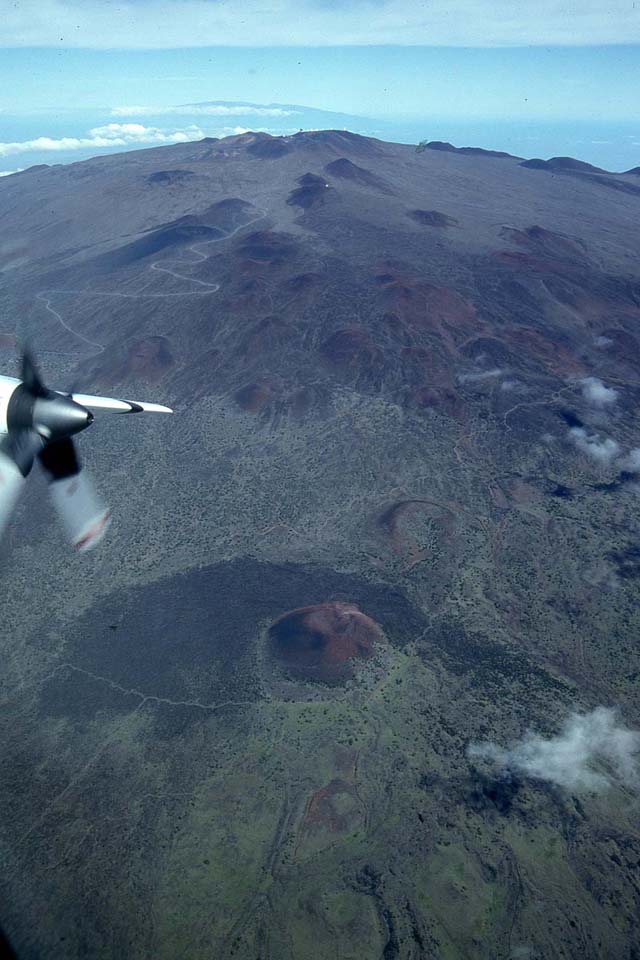 | Figure 3. An aerial view of Mauna Kea'south acme and Due south flank was caused in 1995 from a NASA C-130 aircraft. The Mauna Kea Access Route reaches the summit after numerous switchbacks that cross through fields of cinder cones (note the gray line above the propeller) on the Southward flank. This view is approximately centered on the cinder cone Pu`u Kole, which is one of the features remaining from the Holocene Laupahoehoe eruption. A forest reserve purlieus encloses the upper flanks of Mauna Kea and appears in this photo as a line that makes a sharp corner equally it includes the lower edge of Pu`u Kole. Courtesy of Scott Rowland (Academy of Hawaii at Manoa). |
Eruptive style and activity status. Mauna Kea is presently considered a volcano exhibiting quiescence that has, co-ordinate to the known geologic tape, an extensive history of lapsed activity. Betwixt half dozen,000 and 4,000 years agone, eruptions occurred at at to the lowest degree seven split vents. The record indicates that compared with Mauna Loa, which erupted every few years to few tens of years, and Hualalai, which erupted every few hundred years, Mauna Kea has exhibited long breaks in activity (USGS, 2002).
Based on the occurrence of 12 eruptions within a ten,000 year menses, Mauna Kea's recurrence interval is ~1,000 years (Geohazards Consultants International, Inc., 2000). According to the Mauna Kea Scientific discipline Reserve Chief Program released by the Geohazards Consultants International, Inc. in March 2000:
"Mauna Kea's post-glacial eruptions have been episodic rather than periodic, however, with a item concentration of eruptive activity between four,400-5,600 years ago. The ane,000 year recurrence interval of the past x,000 years does non thus indicate that an eruption is 'overdue', but does reinforce the likelihood that eruptions volition occur sporadically in the future."
This pattern of activity might likewise imply that the next eruption of Mauna Kea could exist followed past others at much shorter intervals, representing a potential clustering of events in the given time interval (Jim Kauahikaua, personal communication, xxx May 2014).
Mauna Kea's most recent eruption occurred ~4,500 years ago, generating both lava flows and cinder cones. This action is considered characteristic of a volcanic system that had evolved by the shield-building stage to the postal service-shield phase (Hoover and Fodor, 1997). The above-stated age determinations were made based on radiocarbon dating of charcoal collected within the Humu`ula soil (Porter, 1971; Wolfe and others, 1997); this soil lies directly beneath the Southward flank lava flows of Pu`ukole and Pu`u Loa Loa (figure 4).
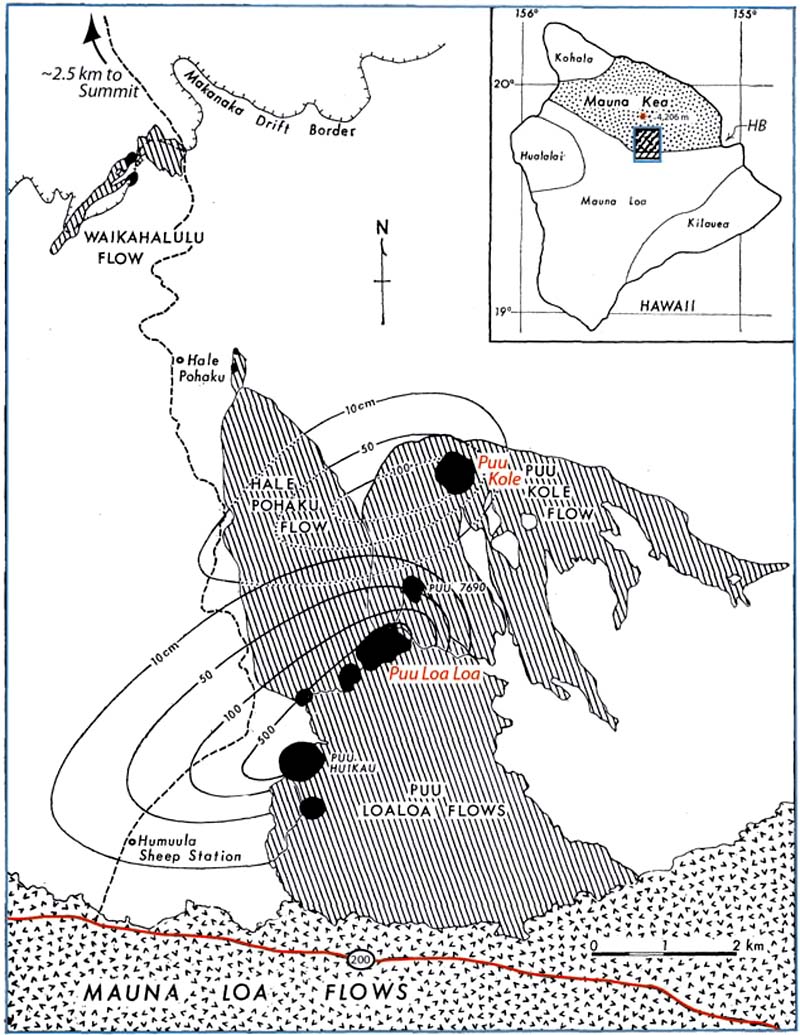 | Figure 4. (Index map) The Isle of Hawai`i encompasses five volcanic centers. Annotation Hilo Bay (HB), the location where the photo in figure 2 was taken. The shaded box shows the expanse of the main map. (Main Map) Holocene cinder cones and lava flows are located on Mauna Kea'due south lower S flank, the lower extent of which have been covered by Mauna Loa lava flows. The two sets of isopachs indicate tephra units vented from the cinder cones Pu`ukole and Pu`u Loa Loa. State Highway 200 (the Saddle Road) is indicated in red, located at the lower margin. The point marked as Hale Pohaku is the location of the Company Data Station and the Onizuka Eye for International Astronomy. Map modified from Porter (1971). |
The designations of shield-building and post-shield stages come up from a system of structural evolution that represents the electric current understanding of Hawaiian volcanism. Significant cinder cone eruptions are a authentication of the post-shield stage as well every bit: "(1) the absenteeism of a acme caldera and elongated fissure vents that radiate across its meridian; (2) steeper and more than irregular topography (for instance, the upper flanks of Mauna Kea are twice as steep as those of Mauna Loa; [figure 5]); and (3) different chemical compositions of the lava" (Clague and Dalrymple, 1987; USGS, 2002).
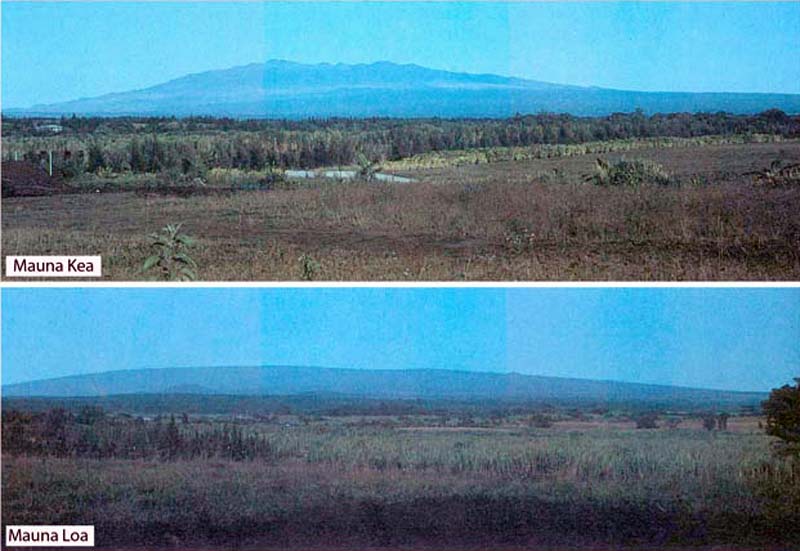 | Effigy 5.Two profile photos of Mauna Kea (top) and Mauna Loa (bottom). Mauna Kea (top) displays an irregular profile due to the abundance of steep-sided cinder cones formed by hawaiite, a less fluid and more explosive lava composition compared with the tholeiitic basalt that characterizes shield-stage volcanism. Mauna Loa (bottom) exhibits the archetype, shield-stage morphology that results due to numerous tholeiitic basalt eruptions (and known to exist specially voluminous). This morphology is relatively smooth and shallow compared with Mauna Kea. USGS photos taken by Taeko Jane Takahashi in 1991 with caption details from Wright and others (1992b). |
Gravity model. Investigations by Kauahikaua and others (2000) adamant a iii-dimensional gravity model for the Island of Hawai`i distinguished the five volcanic centers comprising the island: Kohala, Mauna Kea, Hualalai, Mauna Loa, and Kīlauea (figure half-dozen). The base information for that map came from more than 3,300 gravity measurements made above sea level. Positive gravity anomalies define gravitationally dense zones caused by intrusions and cumulates below the summit and known rift zones of each of the five volcanoes composing the island. Effigy 6 maps the 3-dimensional construction as modeled from the gravity data and expresses the gravity anomalies in terms of elevation from the overlying ground surface.
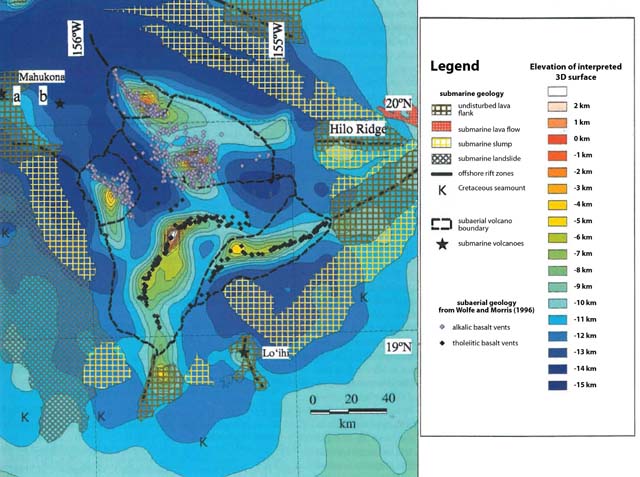 | Figure half dozen. The Island of Hawai`i, including Mauna Kea, in a map showing the distance from the ground surface to the modeled upper surface of dense volcanic cores. Near the eye of the isle, the edifice of Mauna Kea appears covered with alkali basalt vents (gray diamonds). The contour interval represents 1 km. The authors plot known vents and other features such as slumps in order to compare them to the model. The subaerial features were taken from Wolfe and Morris (1996) and the submarine geologic features, from Holcomb (1996). Rift zones are marked past linear distributions of vents; alternative locations for the peak of Mahukona volcano are shown by "a" and "b." Modified from Kauahikaua and others, 2000. |
"Mauna Kea has an elliptical-shaped cadre, slightly elongated e-w, with a broad, linear feature trending southeast. This linear feature may exist a buried rift zone of Mauna Kea, although no surface expressions of those rift zones have been mapped (Kauahikaua and others, 2000)."
The submarine feature known as the Hilo Ridge was also included in the density study with information contributed by GLORIA (a side-scan sonar) as well as satellites ERS-1, Geosat, and Seasat. Prior to this investigation, the Hilo Ridge had been attributed to Mauna Kea as its possible rift zone; withal, the authors adamant a stronger connection with Kohala due to multiple factors including the strongly NW-trending linear zone that extends ~80 km from the modelled core of Kohala.
Early European observations. An early on survey of Hawai`i was conducted past Archibald Menzies, a botanist who accompanied Captain George Vancouver during the cruises of 1792-1794. Menzies successfully ascended Mauna Loa in February 1794 (a team from Helm Cook'southward crew had unsuccessfully attempted the meridian in 1779; encounter effigy 7). Menzies estimated the heights of Mauna Loa and Mauna Kea to within 31 m of the currently accepted value, "a remarkable surveying feat for that time" (Wright and others, 1992b).
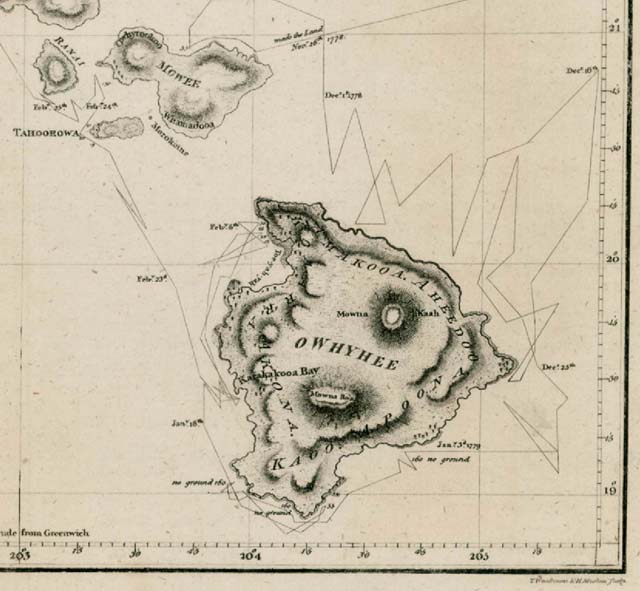 | Figure vii. This map of the Hawaiian Islands has been cropped and centered on the expanse of the Large Island. Mauna Kea and other major landmarks were annotated with the early spelling conventions. According to Wright and others, 1992b, "This was the first map of the island of Hawai`i, made in 1779 past Henry Roberts, a member of Captain Cook'southward coiffure. Four volcanoes are shown, and but the two largest ones are named. Kīlauea is conspicuously absent from this map and from a like one fabricated following Vancouver'due south voyages of 1792-1794. Neither Cook nor Vancouver visited the eastern side of Hawai`i or saw whatsoever volcanic activity." Modified from Wright and others (1992b) and Fitzpatrick (1986). |
The commencement petrologist to study Mauna Kea, R.A. Daly, determined not only that Mauna Kea's upper flanks were dominated past lava flows more than rich in silica (he called them "andesite" although current classifications label them "hawaiite"), but also that the edifice had been modified by glaciers (Wolfe and others, 1997; Daly, 1911). Stearns and Macdonald (1946) and Washington (1923) expanded the knowledge base of operations of Mauna Kea's geochemistry, and Gregory and Wentworth (1937) established that the glacial features from the most recent glacial episode (40,000 to thirteen,000 years ago) were interspersed with primary volcanic material. Wolfe and others (1997) adamant that "eruptive action of Mauna Kea was partly contemporaneous with that at Kohala, Hualalai, and Mauna Loa, and the volcano boundaries are undoubtedly complex."
HVO Volcano Watch article highlights a Mauna Kea forecast. The potential for a future eruption from Mauna Kea was addressed in a Volcano Watch article posted in June 2000 past so Scientist-in-Charge, Don Swanson, from the Hawaiian Volcano Observatory (HVO) (Swanson, 2000ab). The commodity addresses non only eruption frequency only also trends in eruption style, the potential response of the telescope installation at Mauna Kea's summit, and a full general forecast for a likely scenario in the future.
"The next eruption of Mauna Kea."
"Mauna Kea's peaceful appearance is misleading. The volcano is not dead. It erupted many times between lx,000 and 4,000 years agone, and some periods of repose during that time patently lasted longer than 4,000 years. Given that record, future eruptions seem almost certain.
"Before the next i, nosotros should have ample warning provided past our current seismic and geodetic monitoring systems. A number of earthquakes occur beneath Mauna Kea each year, and you lot can bet that we pay shut attention to them. However, they all appear to be associated with tectonic faulting rather than movement of magma.
"The telescopes on top of the volcano may be the first to signal that something is amiss. The coordinates used for tracking their observations volition brainstorm to drift unexpectedly equally the volcano is swelling. In a sense, the telescopes will serve equally very expensive tiltmeters.
"We cannot now say when the next eruption will have place, except that it is unlikely to be in the next several months, given the current lack of whatever precursory signs. Whether the timing is years, centuries, or millennia is entirely unclear.
"But we tin say something almost the likely nature of the next eruption, because we know what the near recent ones were similar, thanks to recently published research past Ed Wolfe [see Wolfe and others, 1997], former staff member of HVO, and colleagues.
"The next eruption could take identify anywhere on the upper flanks of the volcano. Every bit Mauna Kea evolved from its early shield stage (equivalent to Kīlauea and Mauna Loa today) to its present postshield phase, the volcano lost its rift zones. Consequently, the postshield eruptions are not concentrated forth narrow zones but instead are scattered across the mountain. [See figure 6.]
"For example, the most recent eruptive menses, half dozen,000-4,000 years agone, involved eight vents on the southward flank of the volcano between Kala`i`eha cone (virtually Humu`ula) and Pu`ukole (east of Hale Pohaku). During this same period, eruptions took identify on the northeast flank at Pu`u Lehu and Pu`u Kanakaleonui. Lava from Pu`u Kanakaleonui flowed more than than twenty km (12 miles) northeastward, inbound the sea to grade Laupahoehoe Indicate.
"The next eruption will likely produce a lava flow, because each eruption in the past lx,000 years has washed then. The longest flows will attain 15-25 km (9-15 miles) downslope. Most of each menstruation will be `a`a, but pahoehoe may form almost vents.
"A prominent cinder cone volition probably be constructed at each vent. The cinder cones responsible for the "bumpy" appearance of Mauna Kea's surface formed during the sixty,000-4,000-year interval. The cones mentioned by name to a higher place, and several others, were built during the latest eruptive period half dozen,000-4,000 years ago. The next eruption will likely produce a similar cone.
"Cinder cones form at vents that are bespeak sources, not elongate fissures. All activeness is concentrated at one place, and then that fountaining and spattering build a high cone rather than a long rampart. Past eruptions-and hence future ones--probably lasted months to several years, providing enough fourth dimension to construct a substantial cone. Those eruptions spread voluminous ash deposits far across the cinder cones themselves, and the side by side eruption volition probably practice so, too.
"Possibly, however, in that location will not be enough spattering to build a lasting cone. Such an eruption happened about 1 km (0.vi miles) southeast of Unhurt Pohaku, when a vent put out a moderate volume of lava without building a spatter or cinder cone.
"The next eruption of Mauna Kea is unlikely to occur in our lifetimes, only it could. There is no reason to fear such an eruption. It would not threaten human life, provided due intendance were taken, though it could prove devastating to property and infrastructure, particularly if a lava flow traveled to the Hamakua coast or the Waimea area."
Mauna Kea'south seismicity. HVO has monitored and maintained the record of seismicity for the entire region of Hawai`i. The seismicity detected beneath Mauna Kea has been characterized as "exceptional and thin." Notable seismicity occurred in 1994, 2001, and 2011, when earthquakes were large plenty to be felt past the full general public. Island-wide instrumentation immune excellent location data for the local seismicity (figure 8).
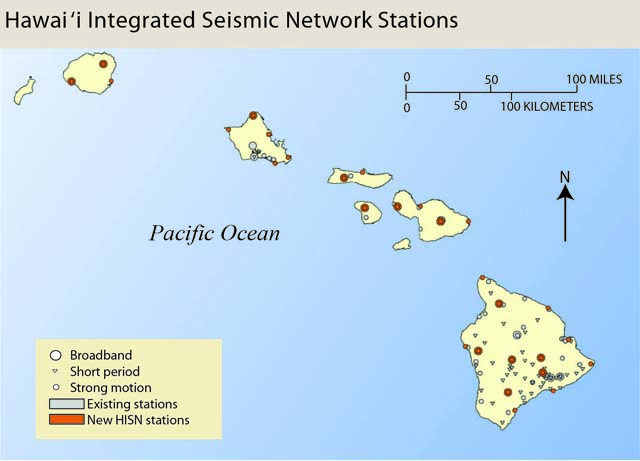 | Figure eight. The seismic network that monitors Mauna Kea and the other volcanoes of Hawai`i spans six islands. This map appeared in the USGS Fact Canvass released in 2011. |
HVO reported that, several times each year, earthquakes from Mauna Kea cause shaking that is noted by local populations - especially the operators of the Mauna Kea astronomical observatory, who rely on stable instrumentation in lodge to brand precise observations. Reports of felt earthquakes from Mauna Kea correlated with magnitude ii.1-4.nine earthquakes during 1973-2012.
Elevated seismicity during October-Dec 2011 resulted in thirty felt earthquakes. Approximately 570 people reported the M 4.v earthquake that occurred on 20 October 2011 and also 10 of the aftershocks that followed (effigy 9). HVO reported that, like many of Mauna Kea's earthquakes, these earthquakes were "well-nigh likely caused by structural adjustments inside the Earth's crust due to the heavy load of Mauna Kea." With an estimated volume of >30,000 km3, Mauna Kea rises ~ten,000 1000 above the seafloor, causing stress to accumulate from the mass of the volcano (Lockwood and Hazlett, 2010).
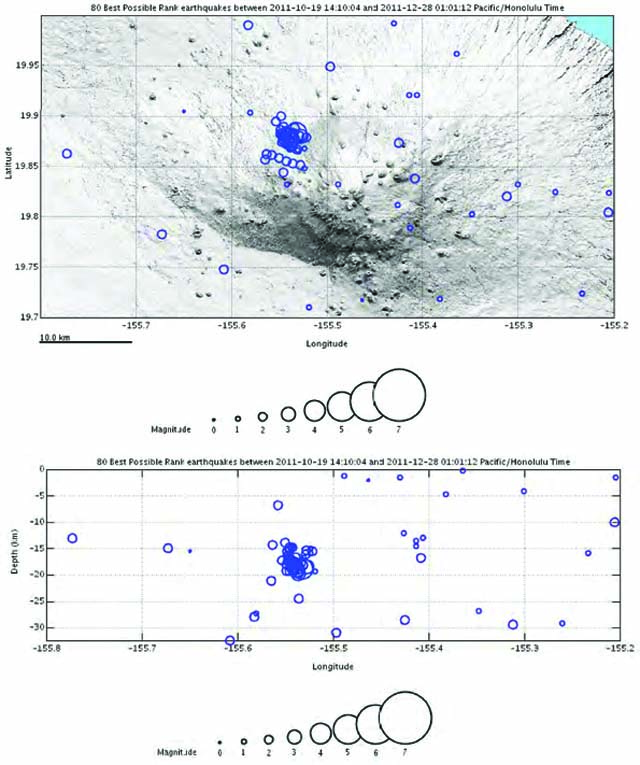 | Figure ix. This map includes the located seismicity from Mauna Kea's seismic sequence between 19 Oct and 31 Dec 2011. Within 10 km of the top, an M four.v convulsion (xx October 2011) and aftershocks occurred. Courtesy of HVO. |
Convulsion swarms at Mauna Kea. HVO reported that earthquake swarms occasionally occur at Mauna Kea. On 23 February 2001, a swarm of ~fifteen events was detected within a 21-hour period. These earthquakes were mainly located ~15 km South of Pa`auilo (~3 km NW of Kuka`iau, figure ten), at a depth of 8-xi km.
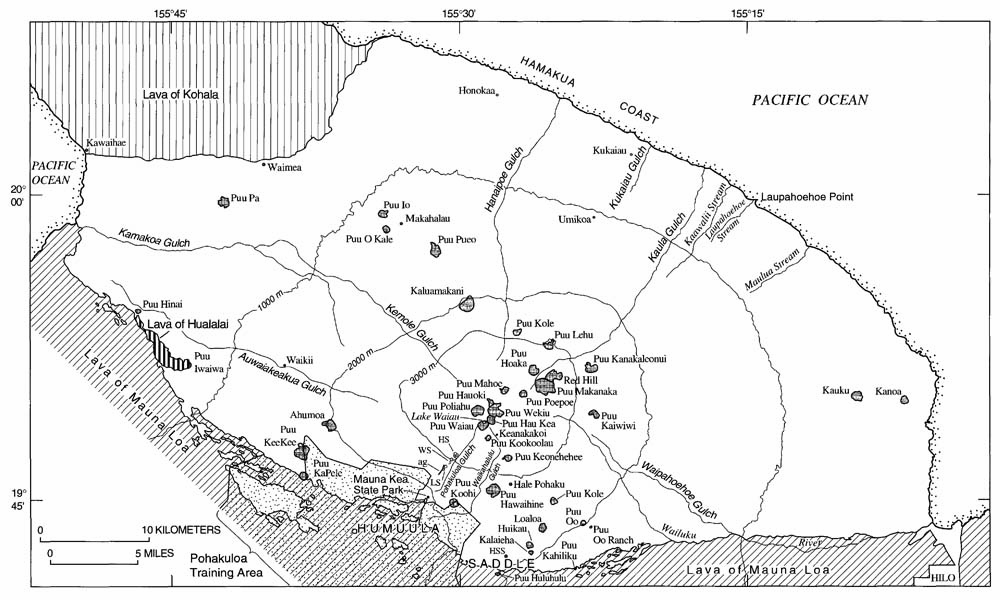 | Figure 10. Geographic features of Mauna Kea included in this map are discussed in this text. Topographic contours are from U.S. Geological Survey, Hawaii County, Sheets i and 2, 1980; 4,000-thousand profile omitted. The following abbreviations are included: ag, the aqueduct gulch; HS, Hopukani Springs; HSS, Humu`ula Sheep Station; LS, Liloe Spring; WS, Waihu Jump. Map modified from Wolfe and others (1997). |
Lake Waiau recedes. The cinder cone Pu`uwaiau, located within 2 km of the top, has independent a freshwater lake that was considered permanent past Wolfe and others (1997) (figures eleven and 12). Lake Waiau has likely persisted due to the in one case-burnished cinders and bombs that take weathered to smectite with zeolites within the void spaces. These alteration products may serve every bit a weak cement betwixt the pyroclasts and reduce the permeability of the cinder cone's base. Desultory wintertime storms have provided almost, if not all, of the water captured in this considerably arid region (Patrick and Delparte, 2014). Contributions from permafrost were besides proposed by Woodcock (1980), but the presence of permafrost has non been confirmed almost Lake Waiau.
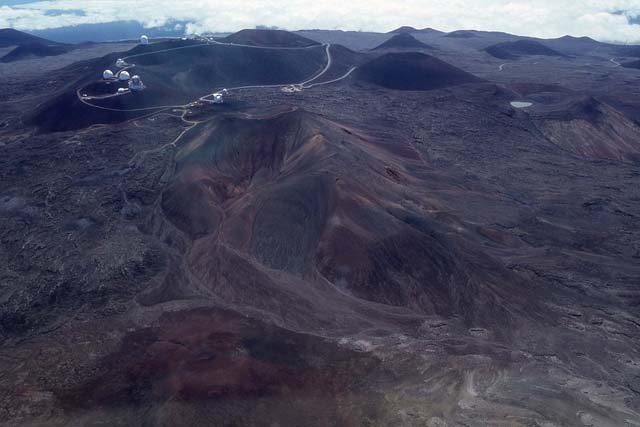 | Effigy 11. An aerial view of Mauna Kea'southward summit was acquired in 1995 from a NASA C-130 aircraft. The highest cinder cone, Pu`u Wekiu, is centered in this view with several astronomical telescopes in view on the left-hand side. The small-scale oval Lake Waiau is on upper the right-hand side of this photo. Courtesy of Scott Rowland (School of Ocean and Earth Science and Technology, Academy of Hawaii at Manoa). |
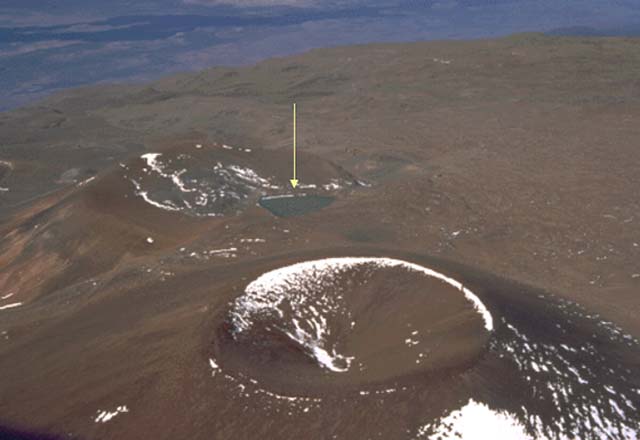 | Figure 12. This aeriform photo includes Mauna Kea'due south Pu`uwaiau where Lake Waiau is indicated with the yellow pointer. The view is approximately SW. A big cinder cone, Pu`uhaukea, is in the foreground. A dark lava flow from Mauna Loa is in the far distance. Courtesy of Richard Wainscoat (Found for Astronomy, University of Hawai`i). |
Patrick and Delparte (2014) reported that the lake size before 2010 was 5,000-seven,000 yard2 with a depth of ~iii yard, but recently, the size has been decreasing apace. In the recent by, the lake was known to overflow through the Pohakuloa Gulch when water levels exceeded the rim (every bit recently as February 2002) (Ehlmann and others, 2005).
Researchers have determined that Lake Waiau is sensitive to precipitation levels (Woodcock, 1980) and that ongoing drought atmospheric condition could be driving the lake's change (Patrick and Delparte, 2014). Based on the National Drought Mitigation Center's data, since 2008, and notably in March 2010, precipitation has been thin at the summit of Mauna Kea.
In Dec 2013, scientists visited the lake and observed an unprecedented sight (effigy 13). Lake Waiau measured a mere 115 mtwo and was roughly x-20 cm deep (Patrick and Delparte, 2014). While the lake size was known to fluctuate over time, this dramatic reduction has caused concern, given the possibility of losing a specialized ecosystem as well as a prominent feature of Hawaiian ethnogeography. Mauna Kea's superlative is considered "one of the most sacred spots in the Hawaiian Islands. Archaeological sites about the summit attest to its prolonged spiritual importance...(Patrick and Delparte, 2014)."
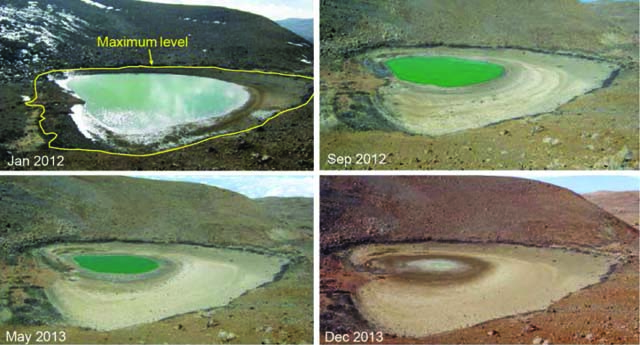 | Figure 13. The rapid drop in Mauna Kea's Lake Waiau h2o level began in 2010. Prior to 2010, the lake area was typically five,000-7,000 m2, with the maximum size outlined in yellow in the peak left image (depth was ~three thou). By late 2013, the lake was just 100-200 gtwo in surface area. Photographs courtesy of Function of Mauna Kea Management and modified from Patrick and Delparte (2014).. |
USGS scientists at HVO as well as collaborators, including Idaho State University, connected to study the atmospheric condition at Lake Waiau subsequently the significant survey was conducted in December 2013. As of May 2014, strong winter rains had partially restored the lake, providing stronger show that the multi-twelvemonth shrinkage was due to the ongoing drought as opposed to changes in the volcanic system.
A note regarding the name Mauna Kea. The popular translation of the Hawaiian name Mauna Kea is frequently "White Mountain," nevertheless, meaning discussions have focused on the source of the proper noun. In that location has been growing consensus that Mauna Kea is a shortened class of Mauna a Wakea, which refers to the heaven male parent Wakea.
According to testaments presented in the Final Environmental Bear upon Statement of the Federal Highway Administration Project No. A-AD-6(1) which included potential cultural impacts on the island by expanding Land Routes 190 and 200, "The mount is the sacred child of Wakea, and it is the source for the country. The mountains and land were genealogically continued to native Hawaiians through the original ancestor, Wakea [sky begetter] and Papa [earth mother]."
Ethnographic enquiry conducted prior to 1999 and released in the affect statement ended that the summit area of Mauna Kea was eligible for the National Annals of Historic Places due to traditional cultural property.
A note regarding Hawaiian names and nomenclature. As previously noted in other Bulletin reports, according to Runyon (2006), "The U.S. Lath on Geographic Names (BGN) is responsible for establishing and maintaining uniform geographical proper name usage throughout all departments and agencies of the Us government. As such, the Lath collects and promulgates every name that is considered official for Federal apply. The official vehicle for promulgating these names and their locative attributes is the Geographic Names Information System (GNIS).
"Until the 1990's, information technology was likewise Federal policy to omit most diacritics and writing marks from placenames on Federal maps and documents. The few exceptions included the Spanish tilde and the French emphasis marks, just otherwise the special characters found in indigenous names were always dropped. In more recent years, however, the BGN has amended its policy to allow the inclusion of such marks, thus more accurately reflecting the true representation of the native language. An example of this has been the addition of the glottal terminate (okina) and macron (kahako) to placenames of Hawaiian origin, which prior to 1995 had ever been omitted. The BGN staff, under the management and guidance of the Hawaii State Geographic Names Authority, has been restoring systemically these marks to each Hawaiian name listed in GNIS."
GVP will strive to conform to GNIS nomenclature. It remains a technological claiming, but a goal.
References: Clague, D.A., and Dalrymple, G.B., 1987, The Hawaiian-Emperor volcanic chain. Office I. Geologic evolution, chap. 1 of Decker, R.W, Wright, T.Fifty., and Stauffer, PH., eds., Volcanism in Hawaii: U.S. Geological Survey Professional Paper 1350, v. 1, p. 5-54.
Daly, R.A., 1911, Magmatic differentiation in Hawaii: Journal of Geology, v. 19, no. iv, p. 289-316.
Federal Highway Assistants, 1999, Final Ecology Impact Statement Role 1: Hawaii State Route 200, Mamalahoa Highway (SR 190) to Milepost half-dozen Saddle Route, County of Hawai`i, State of Hawai`i, FHWA Project No. A-AD-6(one).
Ehlmann, B.Fifty., Arvidson, R.E., Jolliff, B.L., Johnson, S.S., Ebel, B., Lovenduski, N., Morris, J.D., Beyers, J.A., Snider, N.O., and Criss, R.Due east., 2005. Hydrologic and isotopic modeling of Alpine Lake Waiau, Mauna Kea, Hawai`i. University of Hawaii Press, p. 1-xv.
Fitzpatrick, G.Fifty, 1986. The early mapping of Hawaii. Honolulu: Editions Express, vol. i, 160 pp.
Geohazards Consultants International, Inc., Mauna Kea Scientific discipline Reserve Master Program, Volcano, HI, March 2000, 22 p.
Gregory, H.E., and Wentworth, C.Thou., 1937, Full general features and glacial geology of Mauna Kea, Hawaii: Geological Society of America Bulletin, five. 48, no. 12, p. 1719-1742.
Holt, Rinehart, and Winston (2006), Hawaii. Retrieved from http://become.hrw.com/atlas/norm_htm/hawaii.htm.
Hoover, Southward.R. and Fodor, R.V., 1997, Magma-reservoir crystallization processes: pocket-size-calibration dikes in cumulate gabbros, Mauna Kea Volcano, Hawaii, Bulletin of Volcanology, 59, p. 186-197.
Kauahikaua, J., Hildenbrand, T., & Webring, M., 2000. Deep magmatic structures of Hawaiian volcanoes, imaged past three-dimensional gravity models. Geology, 28, ten, p. 883.
Lockwood, J.P., and Hazlett, R.Westward., 2010. Volcanoes: Global Perspectives, Wiley-Blackwell, Hoboken, NJ, ix, 539 p.
Okubo, P.One thousand. and Nakata, J.S., 2011, Earthquakes in Hawai`i-An Underappreciated only Serious Take a chance, Fact Sheet 2011-3013, USGS Fact Sheet, September 2011. (http://pubs.usgs.gov/fs/2011/3013/)
Patrick, G. R. and Delparte, D., 2014, Tracking Dramatic Changes at Hawaii's Only Alpine Lake: EOS (Transactions, American Geophysical Marriage), Vol. 95, No. fourteen, p. 117-118.
Porter, S.C., 1971, Holocene Eruptions of Mauna Kea Volcano, Hawaii, Scientific discipline, Vol. 172 no. 3981 p. 375-377.
Stearns, H.T., and Macdonald, G.A., 1946, Geology and ground-water resources of the Island of Hawaii: Hawaii Division of Hydrography Bulletin 9, 363 p.
Swanson, D.A., (June 2000a). The side by side eruption of Mauna Kea. Volcano Watch. Retrieved from http://hvo.wr.usgs.gov/volcanowatch/annal/2000/00_06_01.html.
Swanson, D.A., 2000b, Don't be fooled by seemingly peaceful Mauna Kea Volcano--it could erupt again: Hawaii Tribune-Herald, June iv, p. two.
USGS-HVO (May 2002). Mauna Kea Hawai`i's Tallest Volcano. Other Volcanoes. Retrieved from http://hvo.wr.usgs.gov/volcanoes/maunakea/.
Washington, H.Southward., 1923, Petrology of the Hawaiian Islands; I, Kohala and Mauna Kea, Hawaii: American Journal of Science, ser. 5, 5. five, no. xxx, p. 465-502.
Wolfe, Eastward.Due west., Wise, W.Due south., and Dalrymple, Thousand.B., 1997, The geology and petrology of Mauna Kea volcano, Hawaii: a study of postshield volcanism. U.S. Geological Survey Professional person Paper 1557, Washington, D.C.: U.S. G.P.O.
Woodcock, A., 1980. Hawaiian alpine lake level, rainfall trends, and spring menstruum, Pacific Science, 34, p. 195–209.
Wright, T.Fifty., Chu, J.Y., Esposo, J., Heliker, C., Hodge, J., Lockwood, J.P., and Vogt, S.Thousand., 1992a, Map showing lava-flow hazard zones, island of Hawaii: U.S. Geological Survey Miscellaneous Field Studies Map MF-2193, scale 1:250,000.
Wright, T.50., Takahashi, T.J., and Griggs, J.D., 1992b, Hawai`i Volcano Scout: A Pictorial History, 1779-1991, University of Hawaii Printing, Honolulu, 162 p.
Information Contacts: Hawaiian Volcano Observatory (HVO), U.S. Geological Survey, PO Box 51, Hawai`i National Park, HI 96718, Us (URL: https://volcanoes.usgs.gov/observatories/hvo/); Richard Wainscoat, University of Hawaii at Manoa, Constitute for Astronomy (URL: http://www.ifa.hawaii.edu/, http://www.ifa.hawaii.edu/images/aerial-bout-95/); Scott Rowland, University of Hawaii at Manoa, School of Ocean and Earth Science and Technology (URL: http://www.soest.hawaii.edu/); and Hawaii News At present (URL: http://www.hawaiinewsnow.com/).
Source: https://volcano.si.edu/volcano.cfm?vn=332030
0 Response to "When Will Mauna Kea Erupt Again"
Post a Comment